Founder letter
Every month we collect everything we've learned about how LLMs pick brands and share it with you.



On 24 August 2026, ChatGPT started showing ads to users across 31 European markets. On 31 August, OpenAI opened self-service buying across Europe, India, the Middle East, and North Africa, and said ChatGPT Ads had reached a $1 billion annualised revenue run rate in under 200 days.
That figure is OpenAI's own, unaudited, and measured as a run rate rather than booked revenue. Treat it as a statement of momentum. Here is the mechanism behind it, what you can control, and what the US evidence looks like after nearly seven months.
The pilot started in the United States on 9 February 2026, for logged-in adults on the Free and Go plans. Plus, Pro, Business, Enterprise, and Edu accounts do not carry ads.
From there:
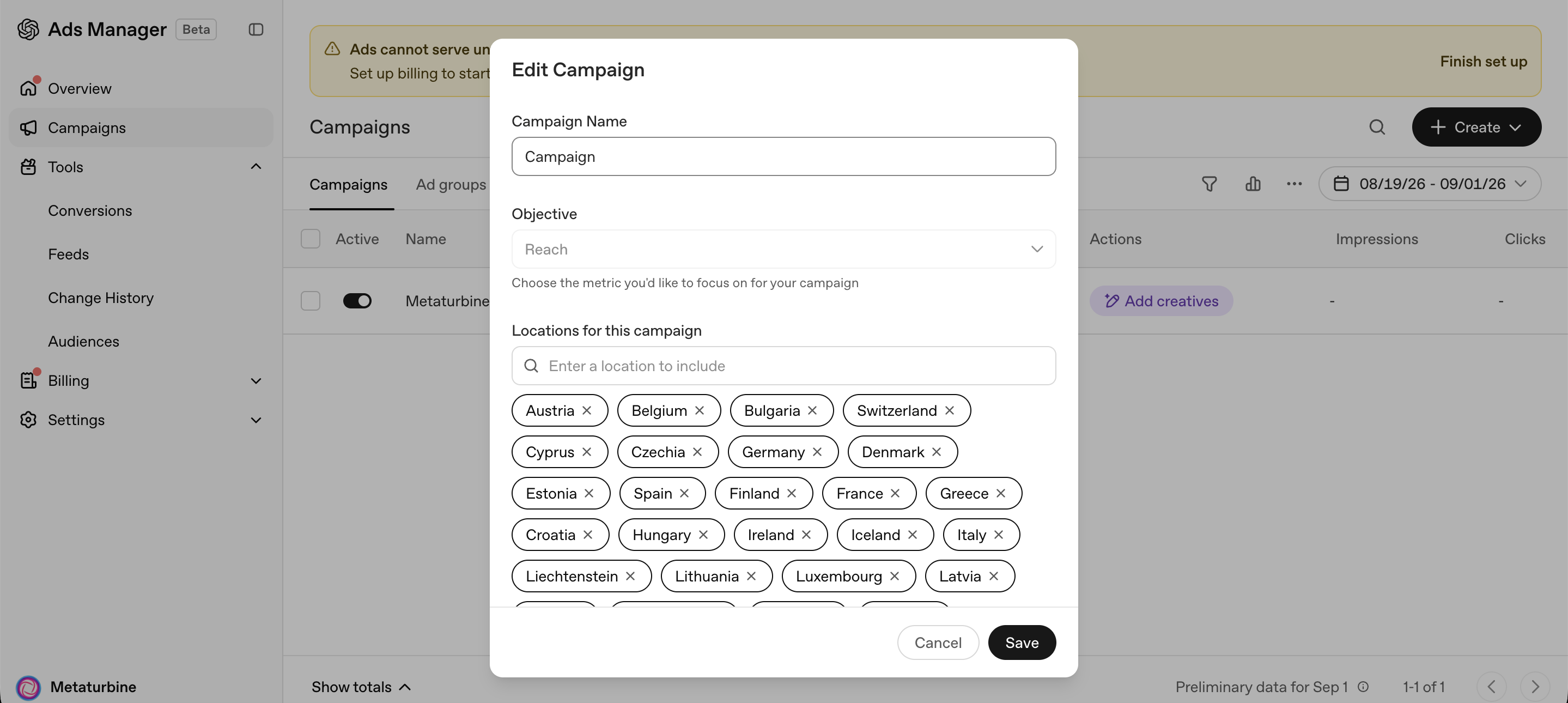
Two country lists exist and they are not the same thing. One covers where a business can register an advertiser account. The other covers where ads can be served and targeted. Brazil and Mexico showed the gap clearly: both were announced in May and opened to advertisers in August, two weeks apart from each other.
As of 1 September 2026, OpenAI's availability table lists self-service access in 47 countries:
Europe (31): Austria, Belgium, Bulgaria, Croatia, Cyprus, Czech Republic, Denmark, Estonia, Finland, France, Germany, Greece, Hungary, Iceland, Ireland, Italy, Latvia, Liechtenstein, Lithuania, Luxembourg, Malta, Netherlands, Norway, Poland, Portugal, Romania, Slovakia, Slovenia, Spain, Sweden, Switzerland.
Americas: United States, Canada, Mexico, Brazil.
Asia Pacific: India, Japan, Korea, Australia, New Zealand.
Middle East and North Africa: Algeria, Bahrain, Lebanon, Morocco, Qatar, Tunisia.
Also: United Kingdom.
The table carries no dates and changes without announcement, so check it against your own account rather than against any article, including this one. On 1 September, a Lithuanian business could open an account, bill in euro, and reach the campaign builder without going through an agency.
This is the part most marketers get wrong on first contact.
There is no keyword bidding. You do not buy a prompt. OpenAI's ads system selects an ad based on the context and intent of the live conversation, weighed against your landing page, your ad title, your ad copy, and the context hints you supply at ad group level. Where a user has ad personalisation enabled, the system may also draw on signals from their broader ChatGPT experience, including past chats, memory, and prior ad interactions. That is a system-side input, and no advertiser-facing control exposes it.
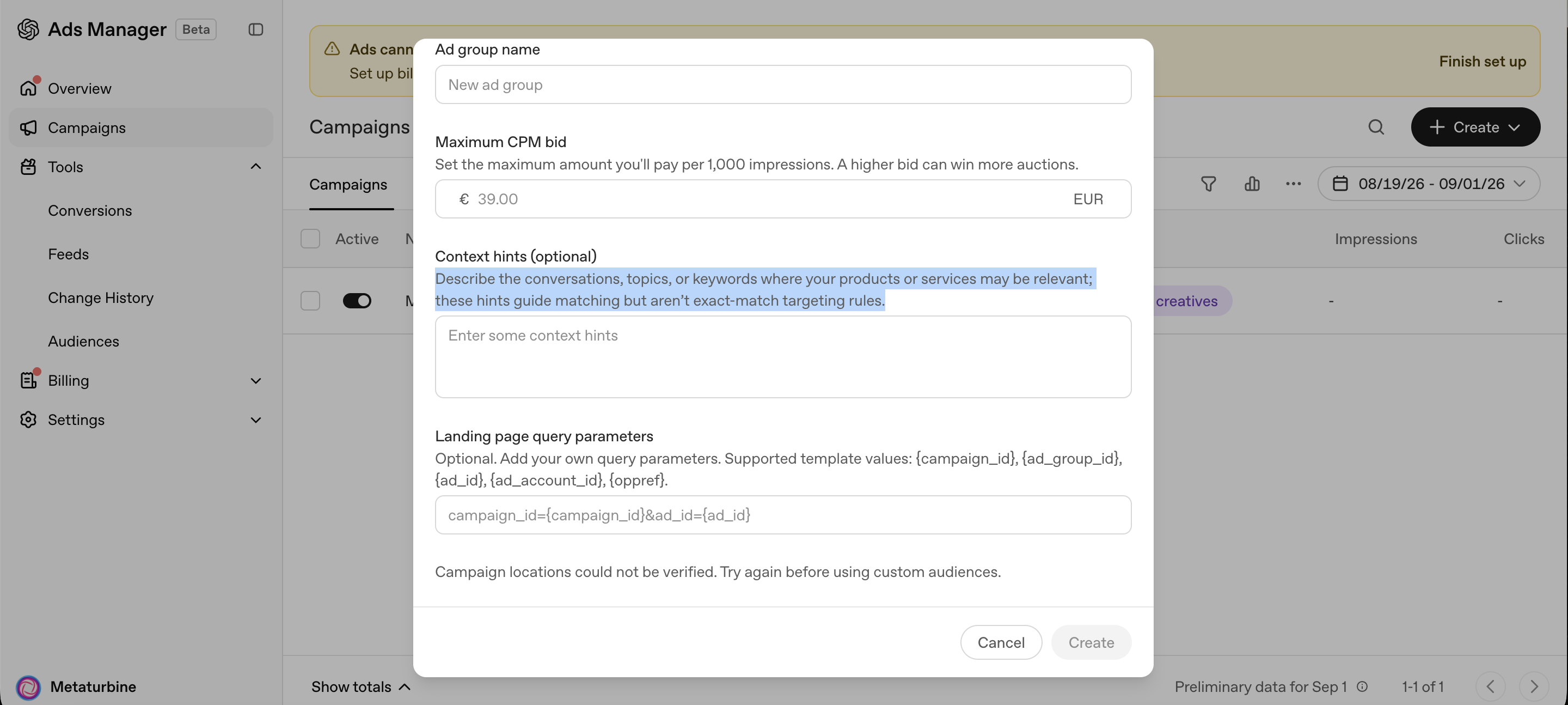
Context hints are natural-language descriptions of the situations where your product belongs. OpenAI's guidance is to describe needs and moments rather than audience labels: its own example replaces "running shoes" with a phrase naming the runner, the training goal, and the shoe's cushioning.
OpenAI states plainly that context hints are not exact-match controls, not audience rules, and not a guarantee that your ad appears against a specific topic. You are describing a semantic region and letting a relevance-weighted, second-price auction decide.
The organic answer and the ad are produced by separate systems, and OpenAI is explicit that advertisers cannot shape, rank, or alter a response. What the two surfaces share is a selection principle: relevance to the meaning of the conversation rather than a match against a typed string. That parallel is worth holding onto, because it is why the skills transfer between them.
At a webinar in August, OpenAI showed a redesigned campaign onboarding flow that it says builds a campaign in under 60 seconds. You paste your website URL and hit Ad Preview. The model reads the site, infers your objective, your product lineup, and your target customer, suggests which ChatGPT user journeys your campaign should surface in, then generates the creative and copy for you to edit.
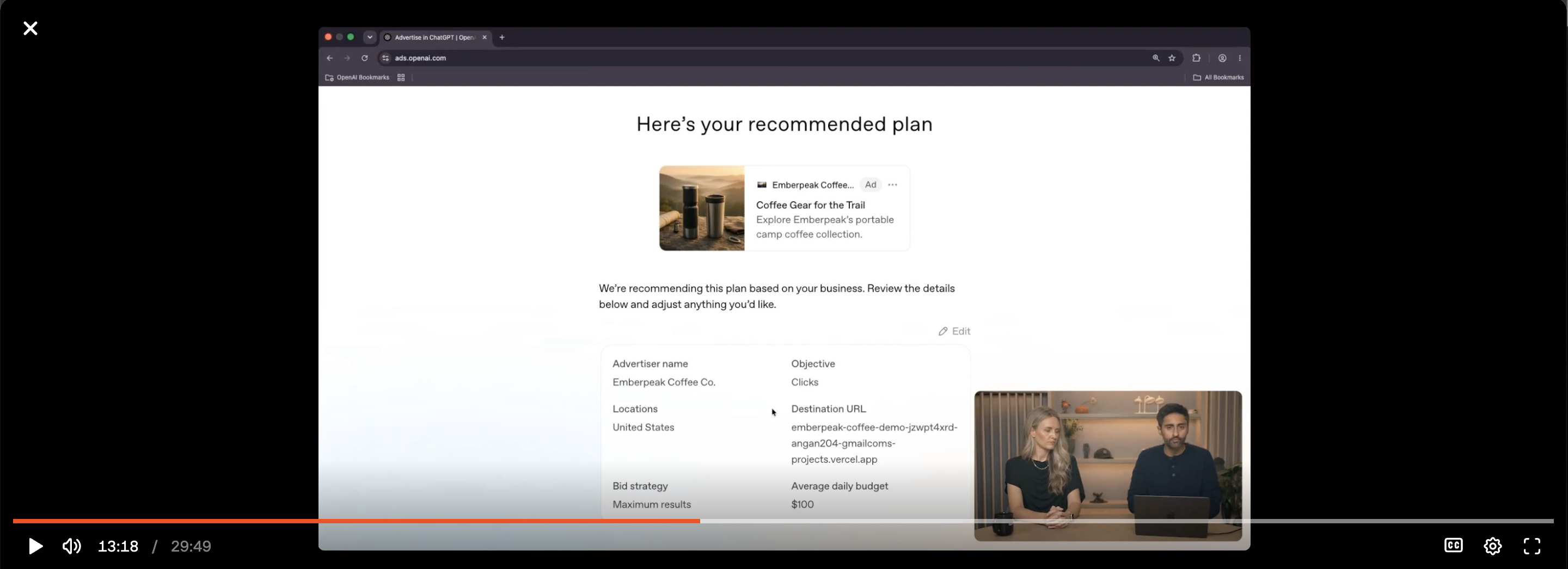
After that it asks for the remaining inputs: geography, bidding strategy, billing.
This is a demo of an interface still rolling out, not a feature you can assume is in your account today. New advertisers are being offered $500 in matching credits against $500 of spend.
OpenAI's stated direction goes further than a faster form. The product team described a future where a business tells an agent inside ChatGPT to bring in more customers on a $500 monthly budget at no more than $5 per reservation, and the agent runs the campaign.
Note what has happened to the entry barrier. Trade reporting in January described the original pilot as a $60 CPM with upfront commitments around $200,000, later stepped down to roughly $50,000 before minimums were dropped entirely. Those figures came from Adweek and The Information rather than from OpenAI.
Today OpenAI publishes minimum daily budgets for ten countries: $25 USD, £15 GBP, 25 AUD, 25 CAD, 25 NZD, 40 BRL, 150 MXN, 725 INR, 2,500 JPY, and 25,000 KRW. No euro figure appears in that table.
The interface has one. A euro-denominated account created on 1 September rejects anything below €15.00 per day, so the European floor tracks the British one rather than the American, roughly 40% below the US minimum. That number is not in OpenAI's documentation, so verify what your own account enforces before you build a budget around it.
Campaign level:
Ad group level:
Ad level:
Measurement:
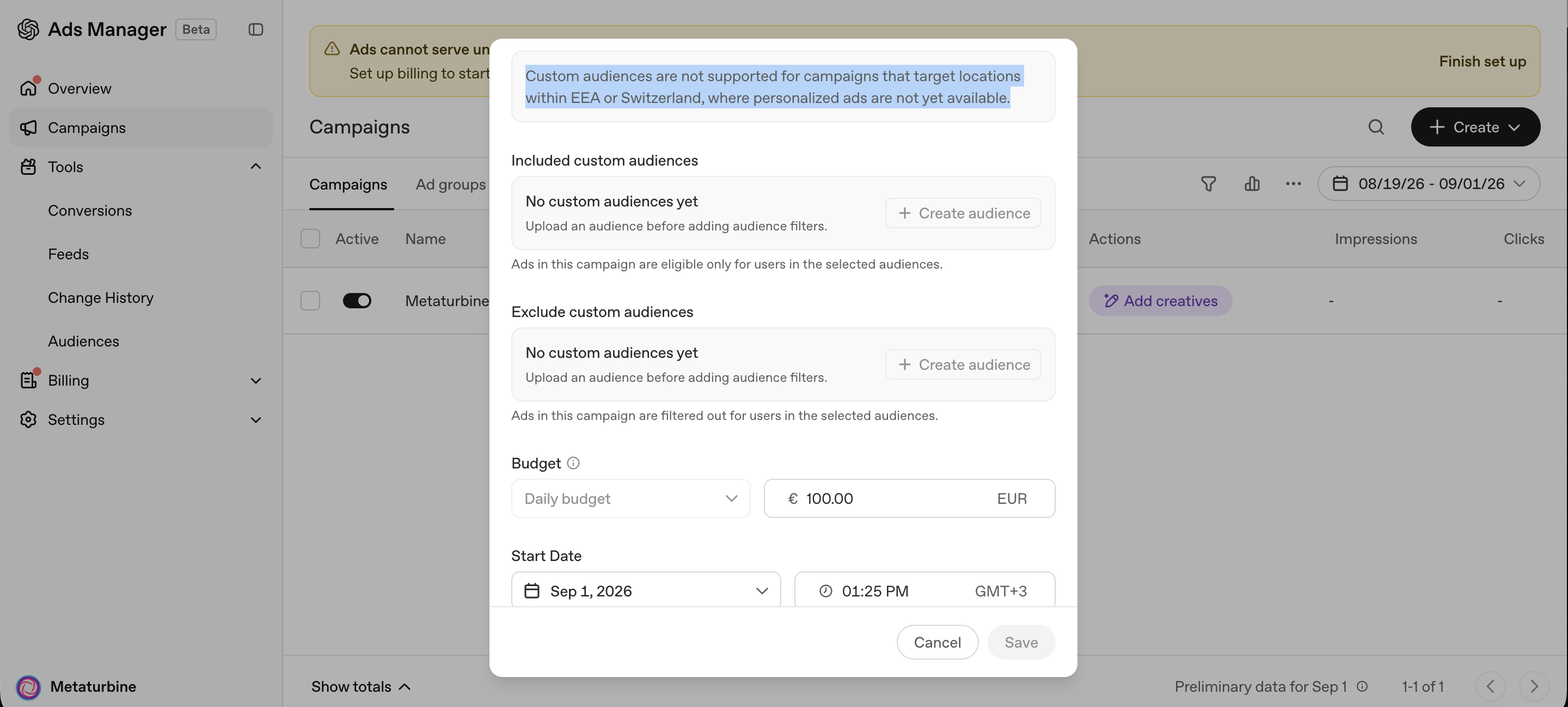
Where custom audiences are available, they need at least 25,000 matched users, with 100,000 recommended. In Europe the question does not arise, since the feature is switched off for EEA and Swiss campaigns entirely.
Worth separating two things that often get merged. Custom audiences are uploaded lists of emails and phone numbers, and Europe loses them. Retargeting by site visitor, lookalike audiences, and demographic targeting are absent from ChatGPT Ads on every market, because OpenAI has not built them. The Measurement Pixel and Conversions API report conversions and do not build audiences. Guides describing how to set up pixel-based retargeting on this platform are describing something that does not exist.
Two eligibility limits worth knowing before you plan creative: ads are not eligible to appear near personal health, mental health, or political conversations, political advertising is not accepted, and ads do not appear in Temporary Chats or the ChatGPT Atlas browser.
One caveat applies to this whole list. OpenAI's documentation runs ahead of the interface, and features arrive account by account. Check what is in your own campaign builder before planning around anything you read about, here or elsewhere.
Personalised ads are not initially available in the European Economic Area or Switzerland. In practice that means European ad selection runs on the current conversation thread plus basic context such as general location and language. Past chats, memory, and ad interaction history are excluded. This is not a small footnote. Where personalisation is available, the system can weigh a user's broader history alongside the live conversation. In Europe, the live conversation is close to the entire signal.
The practical consequence: European inventory is bought against context. Behavioural segments are not available, and neither is first-party audience targeting. Ads Manager blocks custom audiences on any campaign pointed at the EEA or Switzerland, which removes inclusion lists, suppression lists, and audience bid multipliers in one move. A European advertiser cannot exclude existing customers from an acquisition campaign.
OpenAI publishes no cross-advertiser benchmarks and says directly that no single average CTR or CPA can represent the channel. Everything below is either OpenAI's own disclosure or a single advertiser's account data. None of it is audited.
From OpenAI, 31 August:
From advertisers:
That B2B result points at something structural. Ads serve to Free and Go users, and to logged-out sessions. A marketing lead evaluating software on a Plus or Pro account sits outside the ad inventory, except in the logged-out case. This is an inference from how eligibility is defined rather than a measured finding, but it is the first thing a B2B advertiser should test before committing budget.
The ad sits below the answer. The answer is generated first, and it is not for sale.
So the model produces its organic recommendation, and a paid card appears underneath it. A brand present in both holds two positions on one screen. The comparison to owning paid and organic on the same Google result is obvious, though the two surfaces behave differently enough that the comparison is a starting point rather than a conclusion.
The asymmetry is that only one of those positions is purchasable.
There is a second effect worth measuring. A brand name on the screen no longer proves the model chose it. It may have been recommended, or a competitor may have paid to sit next to the answer. Any AI visibility measurement that counts brand mentions without separating earned placement from bought placement is now producing a number that means two different things at once.
Organic position in ChatGPT comes from what the model already associates with your topic. That association is measurable. The distance between where your brand sits and where the model's centre of gravity for your category sits can be calculated, and content can be built to close it.
Run a free scan of what ChatGPT already associates with your brand: metaturbine.com/tools/semantic-brand-scanner
Primary sources: OpenAI (Testing ads in ChatGPT, New ways to buy ChatGPT ads, ChatGPT Ads expands across Europe, A milestone in expanding access to AI, Help Center and developer documentation, all checked 1 September 2026). Interface details, including the euro minimum daily budget and the objective set at campaign creation, were observed directly in a European Ads Manager account on 1 September 2026. Reported figures on pilot pricing come from Adweek and The Information via eMarketer and Digiday. CTR benchmarks attributed to eMarketer are quoted through trade press. Adobe and Criteo conversion figures are quoted through trade press and measure ChatGPT referral traffic rather than ad clicks. Account-level figures are attributed to the agencies that published them.
Ads began serving to European users on 24 August 2026 across 31 markets, the 27 EU member states plus Iceland, Liechtenstein, Norway, and Switzerland. Self-service buying opened across those markets on 31 August.
As of 1 September 2026, OpenAI lists self-service access in 47 countries. The list changes without announcement and carries no dates, so check it against your own account before planning.
Users on the Free and Go plans, plus logged-out sessions. Plus, Pro, Business, Enterprise, and Edu accounts do not carry ads. Accounts identified as belonging to under-18s are excluded, and ads are not eligible near personal health, mental health, or political conversations.
A euro-denominated account rejects anything below €15.00 per day. That figure is not in OpenAI's published table, which lists minimums for ten other currencies. The European floor tracks the British £15 rather than the American $25.
You do not bid on prompts. You write context hints at ad group level, natural-language descriptions of the situations where your product belongs, and a relevance-weighted second-price auction matches them against live conversations. OpenAI states plainly that hints are not exact-match rules and guarantee nothing.
No. Lithuania offers country-level targeting only, with no sub-country options in the picker. A campaign for Vilnius is a campaign for Lithuania.
Not at launch. Personalised ads are unavailable in the European Economic Area and Switzerland, so selection runs on the current conversation thread plus general location and language. Past chats, memory, and ad interaction history are excluded.
No. Ads run on separate systems from the chat model, appear below the response, and are labelled as sponsored. Advertisers cannot shape, rank, or alter what the model says.
Every month we collect everything we've learned about how LLMs pick brands and share it with you.